BC, IBC, TBC, HBC, HPBC... What's the Connection Between All These BC Technologies?
Table of Contents
Introduction
On my first day reporting to the BC production line, the supervisor told me we make TBC, the factory next door makes HPBC, and online people talk about HBC, ABC, DBC... "I can't tell a single one apart. Did I pick the wrong career?" Relax. This article does just one thing: explain the underlying logic behind this string of letters. By the end, you'll realize they actually belong to the same family. In fact, you could say they're just "the same person in different outfits."
Part One: BC Is a Family Name, Not a Given Name
Many people immediately treat BC as a specific cell technology on par with PERC and TOPCon. This is the first trap.
BC = Back Contact
It does not refer to "what passivation technology was used," nor "what doping scheme was used." It only states one thing: the electrodes are on the back, and the front has no gridlines.
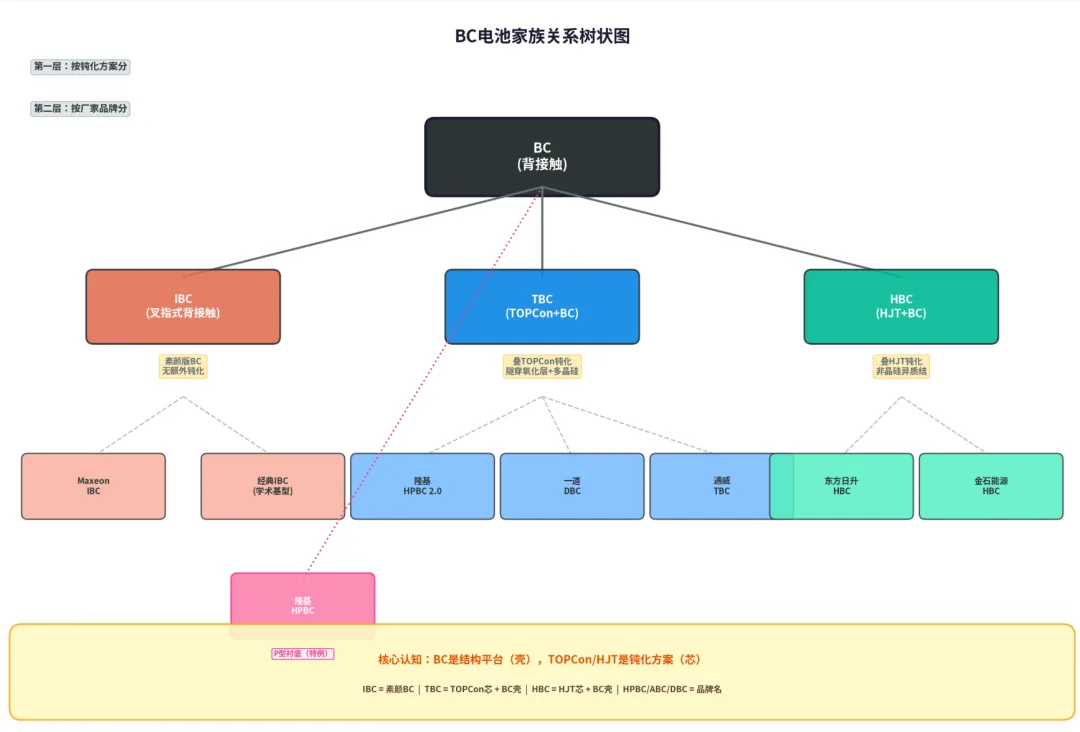
So BC is more like a "surname." The shared trait of cells with the BC surname is a clean front side with all electrodes placed on the back. As for the "given name" (the specific passivation, doping, and metallization used), each maker differs.
An analogy: BC is the category "smartphone," while TOPCon and HJT are the "operating systems." You can run Android (TOPCon) or iOS (HJT), but no matter which system runs, it's still a phone.
This is why the industry calls BC a "platform technology". It provides a structural framework that can accommodate different passivation schemes.
Part Two: IBC, the Base Model of the BC Family
IBC = Interdigitated Back Contact
IBC is the base structure of BC and the most classic BC cell form. Core features:
N-type wafer substrate
Back-side P+ and N+ regions alternating like comb teeth (interdigitated structure)
Back-side metal electrodes aligned respectively to the P+ and N+ regions
No gridlines on the front, only an anti-reflective coating and passivation layer
In 1975, Schwartz and Lammert first proposed the back contact concept. In 1984, Professor Swanson at Stanford University made the point-contact solar cell. The story of IBC began back then.
You can think of IBC as the "bare-faced version of BC" with no extra passivation layered on, relying purely on the interdigitated structure itself.
The question is: IBC efficiency is already very high, but can it go higher?
Answer: stack buffs.
Part Three: Stacking Buffs, the Evolution Path of BC
The structural framework of BC (no front gridlines + back-side interdigitation) is fixed, but the passivation scheme can be swapped. This is the power of a "platform technology."
TBC = TOPCon + BC
Layer the TOPCon tunnel oxide + doped polysilicon passivation scheme onto the BC structure, and you get TBC.
| Comparison | TOPCon | TBC |
|---|---|---|
| Front side | Has gridlines (~3% shading) | No gridlines (0 shading) |
| Back side | Tunnel oxide passivated contact | Tunnel oxide passivated contact + interdigitated structure |
| Passivation scheme | Same as TOPCon | Same as TOPCon |
| Key difference | Conventional bifacial contact | Back contact + interdigitation |
In one sentence: TBC = TOPCon's passivation + BC's structure. Higher efficiency (3% less front shading ≈ Jsc gain of about 1-1.5 mA/cm²), but more complex processing.
LONGi's latest TBC efficiency has already broken 27%, using exactly this path.
HBC = HJT + BC
Layer HJT's amorphous silicon heterojunction passivation scheme onto the BC structure, and you get HBC.
| Comparison | HJT | HBC |
|---|---|---|
| Front side | Has TCO + gridlines | No gridlines |
| Passivation scheme | i-a-Si:H heterojunction passivation | Same as HJT |
| Key difference | Conventional bifacial contact | Back contact + interdigitation |
HBC has the highest theoretical efficiency limit (amorphous silicon passivation is naturally excellent + 0 front shading), but the process temperature window is narrow and equipment investment is large, making mass production the most difficult. Risen Energy and Golden Stone Energy are pursuing this path.
Summary of the two "buff-stacking" routes:
TBC = TOPCon's "core" inserted into BC's "shell" → good process inheritance, TOPCon lines can be retrofitted. HBC = HJT's "core" inserted into BC's "shell" → highest efficiency ceiling, but also the highest mass-production threshold.
Part Four: Manufacturer Naming, Same Logic, Each Calling It Their Own
The IBC, TBC, and HBC above are technical route names commonly used across the industry. But each manufacturer also has its own product brand names, which makes things even more confusing for newcomers.
| Manufacturer | Product Brand Name | Technical Essence | Notes |
|---|---|---|---|
| LONGi | HPBC | P-type substrate BC | Hybrid Passivated BC, first generation used P-type wafers |
| LONGi | HPBC 2.0 | N-type substrate BC | After upgrade, essentially approaching TBC |
| Aiko | ABC | N-type back contact | All Back Contact, based on N-type IBC structure |
| Yidao | DBC | DAO-BC | Yidao's own BC scheme |
| Maxeon | IBC | Classic IBC | SunPower/Maxeon's veteran route |
See the pattern? A manufacturer's product name = technical route + brand label. HPBC is essentially P-type BC, ABC is essentially N-type IBC, and IBC is just IBC. The technical core never escapes the few routes mentioned above.
Just like "Huawei Mate" and "Xiaomi 14" are both called phones, only with different brands. HPBC and ABC are both BC, only from different manufacturers.
Part Five: Three Common Misconceptions, Cleared in One Go
Misconception 1: "BC is an independent technology competing with TOPCon/HJT"
Wrong. BC is a structural innovation, while TOPCon/HJT are passivation innovations. Two different dimensions. BC can be layered with TOPCon (= TBC) or with HJT (= HBC). They are not in a "competition" relationship but a "combination" relationship.
Misconception 2: "HPBC is the same as HBC"
Wrong. The H in HPBC stands for Hybrid (hybrid passivation), while the H in HBC stands for Heterojunction. The names look alike, but the technical routes are completely different. HPBC uses P-type wafers + hybrid passivation, while HBC uses N-type wafers + amorphous silicon heterojunction passivation.
Misconception 3: "IBC has been phased out; now it's all TBC/HBC"
Not entirely correct. As the base model, IBC remains the structural foundation of all BC cells. Both TBC and HBC layer passivation onto the IBC structure. Maxeon still mass-produces classic IBC to this day, with efficiency that is far from low. It's only that from the standpoint of efficiency ceiling, stacking buffs does indeed go higher.
Conclusion
BC is the shell, TOPCon/HJT are the core, IBC is the bare face, TBC/HBC are the buff-stacked versions, and HPBC/ABC/DBC are the brand names.
Get these four layers straight, and you can decode every letter.
Next time the supervisor says "our line makes TBC," you'll know exactly what's going on: oh, it's TOPCon's passivation inserted into the BC structure, no front gridlines, back-side interdigitated arrangement. Got it.
ooitech believes: BC is not a rival to TOPCon or HJT but a structural platform onto which different passivation technologies can be layered, and understanding this family relationship makes every BC acronym instantly clear.