How a Tabber & Stringer Works — and How to Choose One in 2026
Table of Contents
Introduction
Anyone in module manufacturing knows it: whether your modules reach high power and survive a 25-year warranty hinges on the stringer. It's the throat of the line — the step that solders single cells into a string — and once a cell cracks or micro-cracks, the loss can never be recovered. This article first walks you through how it works, then explains the pitfalls to avoid in 2026, and finally recommends a machine that is genuinely full-route compatible.
How a Stringer Works
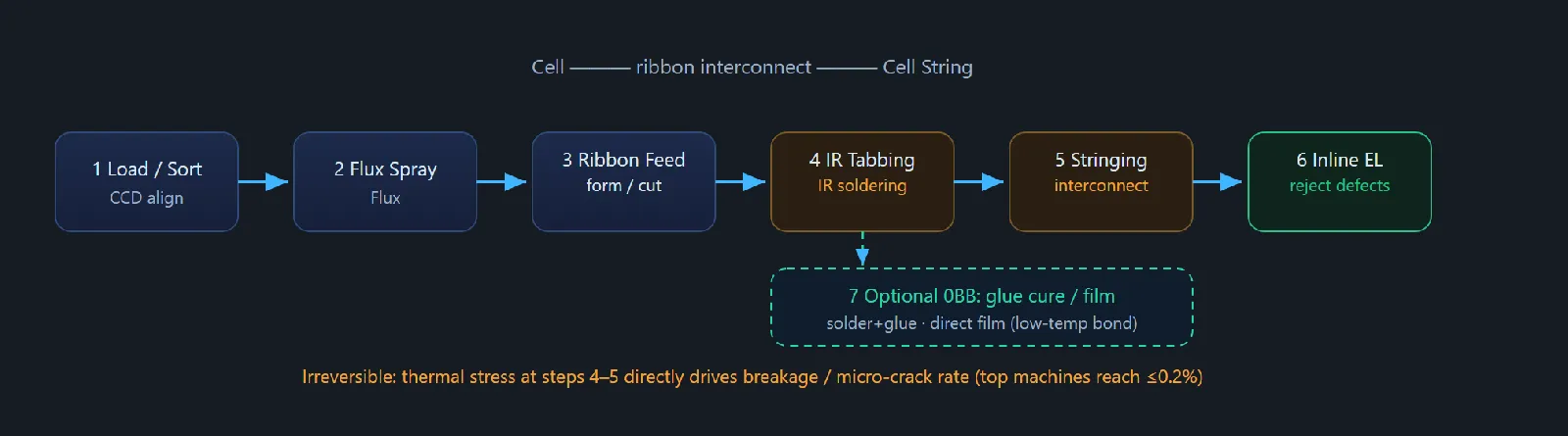
A Tabber & Stringer solders solar cells together — one by one, via tinned copper ribbon — into a string. Its place on the line is critical: it sits after cell sorting and before layup/lamination, making it the first irreversible process on the path from cell to module.
The Six Stations
Fig. 1: Six-station flow — load & sort → flux → ribbon forming → IR tabbing → stringing → inline EL. 0BB lines add a glue / film station after soldering (green dashed box).
The Heart of It: How Cells Get Strung Together
The principle is intuitive: the ribbon is soldered onto the front of one cell, then routed to the back of the next cell — front-to-back, the cells are linked into a current loop. Heat melts the solder on the ribbon so it forms a metallurgical bond with the cell's grid lines. How well that heating profile is controlled decides whether the thin, fragile wafer ends up with micro-cracks.
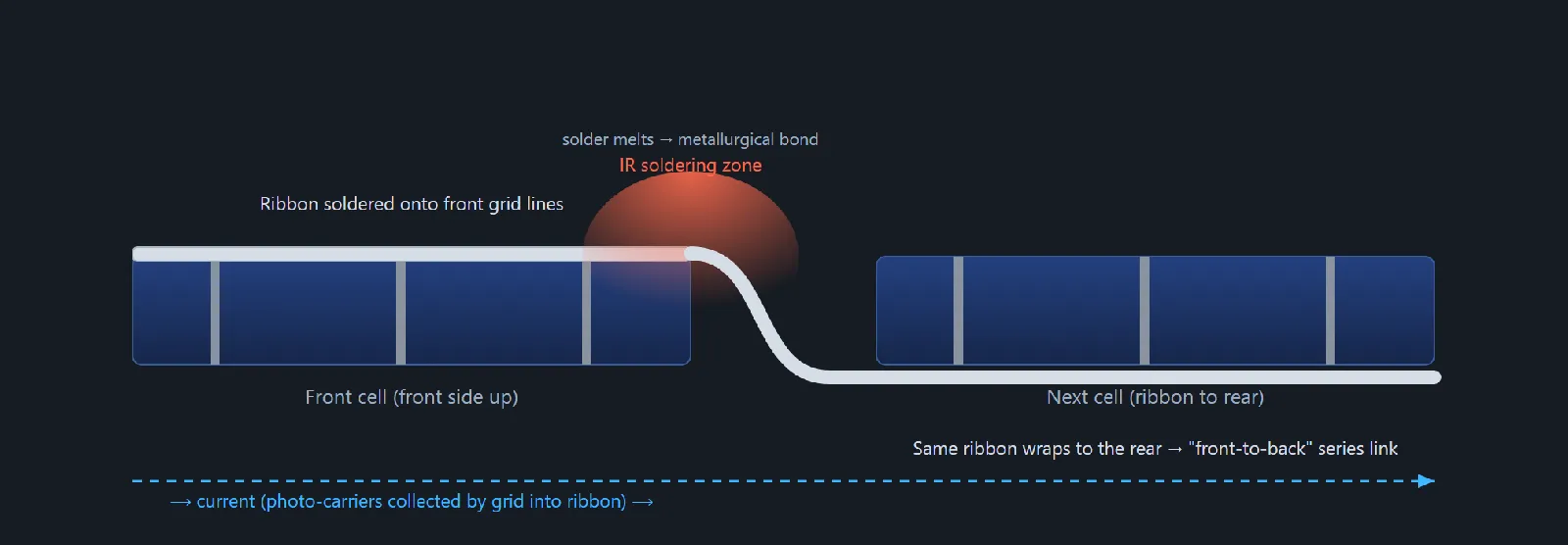 Fig. 2: The core principle — the ribbon links one cell's front to the next cell's back, forming a current loop; IR heat fuses the solder to the grid lines, and the temperature profile directly governs the micro-crack rate.
Buying a Stringer in 2026: What to Look For
1. Soldering method: go with infrared (IR); hot air is obsolete
Plenty of old material still lists IR / hot air / laser / induction side by side. But by 2026 the industry has converged: infrared (IR) soldering is the clear mainstream — non-contact, mature, cost-effective — while hot-air soldering has largely left the mass-production stage: poor heating uniformity, slow cycle time, and unfriendly to ever-thinner wafers. So don't agonize over does it support hot air; just confirm an IR platform — and focus instead on whether it can upgrade to 0BB.
| Method | Status | Characteristics |
|---|---|---|
| Infrared (IR) | Dominant / Mainstream | IR-lamp heating of ribbon solder; non-contact, mature, cost-effective, tunable thermal control |
| Hot Air | Obsolete | Poor heating uniformity & cycle time, harsh on thin wafers; rare on new lines |
| Laser | Niche | Localized, low-temp, tiny heat-affected zone, but high equipment cost |
| Induction | Niche | Electromagnetic-induction heating; used by a few machines only |
2. Busbar tech: moving from SMBB toward 0BB (zero busbar)
The biggest shift in stringers in recent years is busbars from many to none: MBB (multi-busbar) → SMBB (super multi-busbar, 15–25BB) → 0BB (zero busbar). 0BB solders fine round wires directly onto the fingers, saving silver paste, cutting shading, and raising power. Forecasts put 0BB penetration near 90% by 2026 — meaning that when you buy equipment today, it must be able to run 0BB, or it risks being outdated within two years.
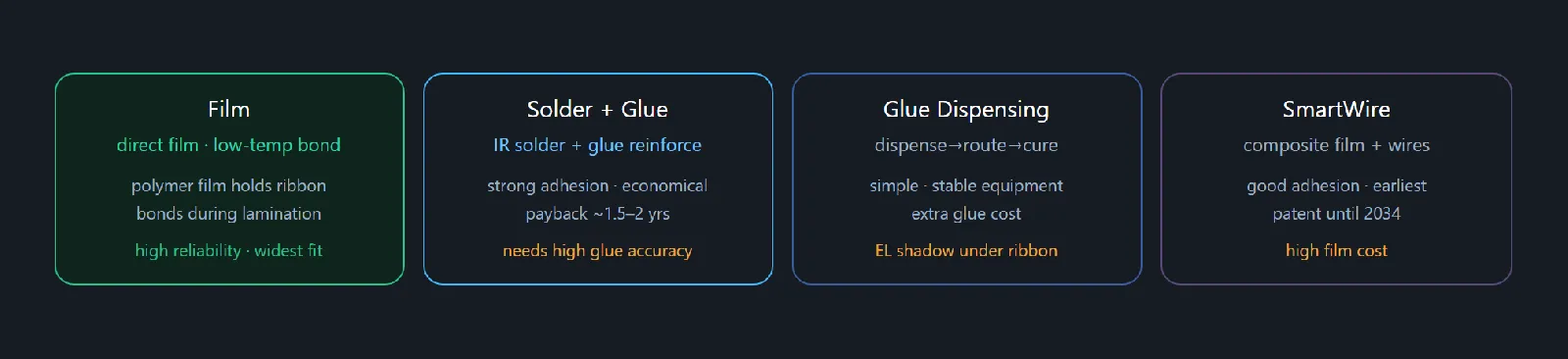 Fig. 3: The four 0BB interconnection routes. Film offers the highest reliability and the widest fit (TOPCon/HJT/BC); solder+glue is built on IR soldering and the most economical in mass production — the most natural 0BB upgrade path for an IR stringer.
3. Cell compatibility: can it handle them all on one machine?
The technology roadmap hasn't settled — PERC, TOPCon, HJT and BC all have their markets. If your line might switch routes, or you do tolling for different customers, then compatibility is worth more than peak throughput. The good news: 0BB-era film/glue processes inherently suit TOPCon, HJT and BC, turning one machine for many routes from an ideal into reality.
| Cell type | Key stringing point | Mainstream approach |
|---|---|---|
| PERC | Mature, cost-sensitive | IR soldering (MBB/SMBB) |
| TOPCon | N-type, SMBB→0BB | IR soldering / 0BB solder+glue |
| HJT | Low-temp sensitive, thin wafer | IR low-temp / 0BB film·glue |
| BC (IBC/ABC/HPBC) | Back-contact, no front busbar | Dedicated back-contact / 0BB interconnect |
4. The things most often overlooked — but that matter most
Breakage / micro-crack rate: stringing is irreversible — this is the linchpin of yield and warranty cost. Top machines reach ≤0.2% on Grade-A cells.
Placement accuracy: as 0BB/SMBB grid lines get finer, alignment precision directly affects solder quality.
Inline inspection: CCD vision + multi-camera EL to catch defects before the irreversible step.
Throughput & changeover: match the line takt, but never trade breakage rate for raw CPH.
Full line & service: whether the vendor offers a complete line from stringing to lamination and framing, plus local service and spare-parts response.
Recommended: Ooitech SS-1500B Compatible Stringer
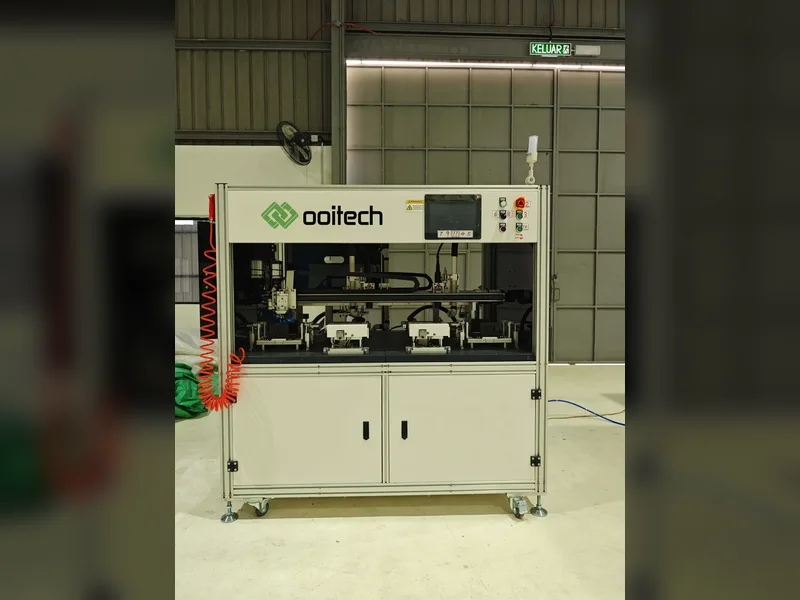
Run the checklist above against it, and the Ooitech SS-1500B looks practically tailor-made for the realities of 2026: it's built on a mature, reliable infrared (IR) soldering platform, natively compatible with BC / TOPCon / PERC / HJT (yes, even the toughest one — back-contact BC), and on top of that it can be customized with glue-dispensing / film processes to upgrade smoothly to 0BB. In one line: one machine, minimal risk of betting on the wrong route.
SS-1500B Key Specs
| Item | Specification |
|---|---|
| Soldering | Infrared IR |
| Cell types | BC / TOPCon / PERC / HJT |
| Throughput (TOPCon/PERC) | 1200 pcs/h |
| Throughput (BC) | 1000 pcs/h |
| Breakage (Grade-A) | ≤ 0.2% |
| Positioning | ±0.15mm |
| Placement | ±0.2mm |
| Max speed | 1000 mm/s |
| Cell size | 166–210 × 30–166mm |
| Ribbon (flat) | W 0.35–1.0, T 0.12–0.25mm |
| Max string | 1800 mm |
| Ribbon units | 18 sets |
Automation: fully automatic loading/unloading · CCD vision · four-axis SCARA robot positioning · integrated EL inspection (3 cameras).
Why choose it
Mature IR platform: non-contact IR soldering — stable, cost-effective, tunable thermal control
Four cells, natively: BC/TOPCon/PERC/HJT covered by one machine
0BB-upgradable: customizable glue/film to step into the zero-busbar era
Breakage ≤0.2%: protects yield at the irreversible step
High precision + inline EL: ±0.15mm placement + 3-camera EL catch defects early
One investment, many routes: avoid re-buying equipment when the roadmap shifts
Best fit for
Multi-product / tolling lines: frequent switching among BC/TOPCon/HJT
Small-to-mid module makers: one investment avoids betting on the wrong route
0BB fence-sitters: run IR now, upgrade to glue/film when ready
R&D / pilot lines: validate multiple cells and processes on one machine
Overseas builds: a complete line plus local support
One machine — covering PERC / TOPCon / HJT / BC. Bring your own cells for a trial run + EL test, and validate it against your line with real data on breakage, micro-cracks, peel strength, and 0BB yield.
FAQ
Q: Why not recommend a hot-air stringer?
By 2026, hot-air soldering has largely left mainstream mass production due to poor heating uniformity, slow cycle time, and harsh thermal shock on thin wafers. For a new line, just choose an IR platform and focus on its 0BB upgrade capability.
Q: The SS-1500B is IR — so how does it do 0BB?
The most mainstream 0BB route, solder + glue, works exactly this way: first use IR to tack the ribbon to the fingers, then add thermoset glue to reinforce — an IR stringer is the natural host for this route. The SS-1500B builds on IR and can be customized with glue/film for 0BB.
Q: Film or solder+glue — which 0BB route should I pick?
Film offers the highest reliability and the widest fit (TOPCon/HJT/BC), but the carrier film adds a little cost; solder+glue is the most economical in mass production with ~1.5–2 yr payback, but demands higher glue-dispensing accuracy. Most new TOPCon lines choose between these two.
Q: What's the single most important metric to watch?
Breakage and micro-crack rate (EL). Stringing is irreversible — breakage means scrap, and micro-cracks slowly magnify into power degradation over 25 years. Chasing only unit price and CPH tends to lose the gains back through yield and warranty costs.
In Short
When choosing a stringer in 2026, remember two things — go IR for soldering (hot air is obsolete), and make sure it can run 0BB. If you want one machine to cover PERC / TOPCon / HJT / BC while keeping an upgrade path, a mature IR platform + four-cell compatibility + customizable glue/film + ≤0.2% breakage is well worth a close look. Diagrams are schematic.
Ooitech认为:In 2026, choose an IR stringer that can upgrade to 0BB and run PERC, TOPCon, HJT and BC on one platform — because stringing is irreversible, breakage rate and route compatibility matter more than raw throughput.