PERC vs TOPCon vs HJT vs BC: Why Solar Cells Differ So Much in Price and Efficiency
Table of Contents
The Core Question of This Issue
From P-type to N-type, from PERC to TOPCon, HJT and BC, what do these letters actually mean? What different problems are they solving, and what should supply-chain professionals look at when selecting them?
Supplier A says: "Our TOPCon module reaches 22.5% efficiency, one point higher than PERC." Supplier B says: "Our HJT module has a better temperature coefficient and generates more power in hot conditions." Supplier C says: "Our BC module has no gridlines on the front, it looks cleaner and suits distributed projects."
So how should you compare them? If you only look at price and rated efficiency, you will miss the things that really matter:
Different technology routes have different mass-production yields, which affects delivery stability.
Silver paste consumption differs (HJT is higher), which affects cost trends and supply risk.
Degradation mechanisms differ (P-type has LID, N-type has LeTID), which affects warranty claims.
Process temperatures differ (HJT is a low-temperature process), which affects equipment, investment thresholds and the overall supplier landscape.
This issue helps you build a complete framework for comparing technology routes.
Understanding It in One Sentence
PERC is the peak of P-type technology (rear passivation), TOPCon is the mainstream N-type mass-production route (contact passivation), HJT is the high-performance low-temperature route (heterojunction interface passivation), and BC moves the electrodes to the back as an aesthetic solution. They solve the same problem from different angles: reducing efficiency losses.
A Plain Analogy
Solar cell efficiency loss is like a five-story house that leaks water on every floor:
First floor leak (absorption loss): light passes straight through without being absorbed.
Second floor leak (thermalization loss): the surplus energy of high-energy photons turns into heat.
Third floor leak (recombination loss): electrons and holes recombine before being separated.
Fourth floor leak (resistance loss): current meets resistance in the cell and electrodes and turns into heat.
Fifth floor leak (shading loss): the front electrodes block part of the sunlight.
PERC mainly repairs the third floor (rear recombination). TOPCon mainly repairs the contact part of the third floor (contact recombination). HJT almost completely renovates the third floor (interface passivation). BC mainly repairs the fifth floor (moving electrodes to the back to eliminate shading).
Supply-chain note: different routes repair different floors, but the cost and difficulty of repairing each floor varies. What you choose is not just an efficiency number, but a trade-off of "where to invest, how much loss you can save, and what price you pay."
Professional Principles
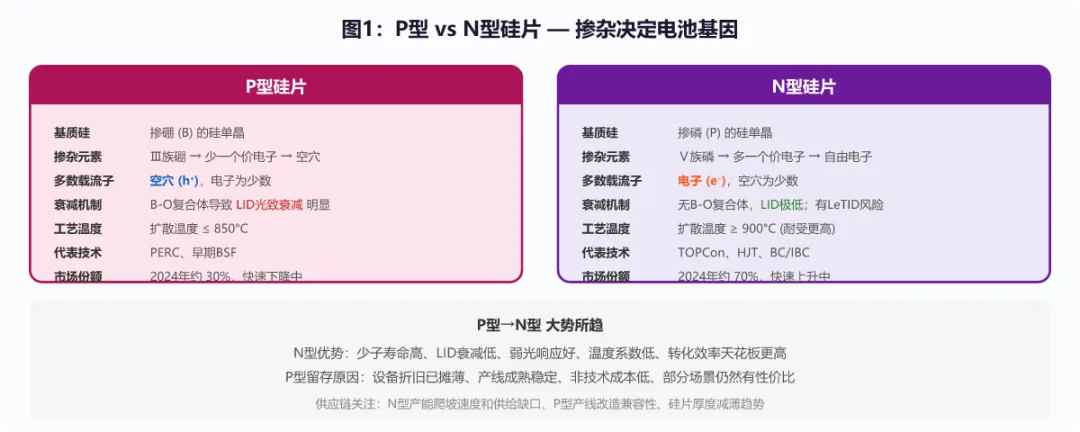
P-type vs N-type: the choice of substrate
| Item | P-type Wafer | N-type Wafer |
|---|---|---|
| Doping | Boron | Phosphorus |
| Majority carrier | Holes | Electrons |
| LID degradation | More noticeable (boron-oxygen recombination) | Lower |
| Impurity sensitivity | Higher | Lower (higher minority carrier lifetime) |
| Representative tech | PERC | TOPCon, HJT, some BC |
Trend: N-type is replacing P-type as the mainstream, because the minority carrier lifetime of N-type wafers is higher (electrons live "longer"), and combined with more advanced passivation it can reach higher efficiency.
PERC: adding a protective film on the back
PERC stands for Passivated Emitter and Rear Cell. On the back of a traditional P-type cell it adds:
A layer of Al2O3 (aluminum oxide) passivation to reduce rear recombination.
A layer of SiNx (silicon nitride) protection to increase rear reflection, bouncing unabsorbed photons back for a second chance at absorption.
Main losses addressed: rear recombination plus rear transmission loss.
Supply-chain features: most mature technology, most complete supply chain, lowest cost, but an efficiency ceiling around 23.5%. It is the largest installed base, with the easiest spare parts and replacement.
TOPCon: a precision contact gate
TOPCon stands for Tunnel Oxide Passivated Contact. The key structure: on the back of an N-type wafer, a very thin oxide layer (SiO2, about 1-2nm) is made, then covered with a doped polysilicon layer.
The oxide layer acts like a gate, blocking minority carriers (holes) from recombining while allowing majority carriers (electrons) to tunnel through (this is the "tunneling").
The doped polysilicon layer provides good electrical contact and lowers contact resistance.
Main losses addressed: recombination at the metal contact region plus contact resistance.
Supply-chain features: highly compatible with PERC lines (upgradeable) and currently the main N-type mass-production route. Watch silver paste consumption, oxide-layer process yield and degradation data.
HJT: two protective layers sandwiching a wafer
HJT stands for Heterojunction Technology. Structure: on both sides of an N-type crystalline wafer, a layer of intrinsic amorphous silicon (i-a-Si:H) is deposited as passivation, then covered with a doped amorphous silicon layer, and finally a transparent conductive oxide (TCO).
"Hetero" means crystalline silicon and amorphous silicon are two different semiconductor materials.
The two i-a-Si:H layers provide excellent surface passivation.
The whole process is completed at low temperature (<200°C, whereas PERC/TOPCon need 800°C+).
Main losses addressed: surface recombination plus temperature loss (lower temperature coefficient, better performance in heat).
Supply-chain features: high efficiency and good temperature behavior, but large equipment investment, high silver paste consumption and a need for targets (ITO for the TCO). The low-temperature process means it is incompatible with existing high-temperature lines and requires new capacity.
BC / IBC: moving electrodes to the back
BC stands for Back Contact, and IBC for Interdigitated Back Contact. The front of a traditional cell has metal gridlines (electrodes) that block roughly 5%-7% of sunlight. BC technology places all positive and negative electrodes on the back, leaving the front completely unshaded.
How it works: P+ and N+ regions are alternately arranged on the back to form local PN junctions, with positive and negative electrodes interdigitated.
Main losses addressed: front electrode shading.
Supply-chain features: a clean front (no gridlines) and high efficiency, but a complex process, big yield challenges and many patent barriers. It suits the high-end distributed market.
Efficiency loss map overview
| Loss type | Principle | PERC | TOPCon | HJT | BC |
|---|---|---|---|---|---|
| Absorption loss | Photons pass through/reflect | Rear reflection improved | Same | Same | No front shading |
| Thermalization loss | Surplus energy of high-energy photons becomes heat | Same (tied to bandgap, hard to change by route) | Same | Same | Same |
| Surface recombination | Surface defects trap carriers | Front passivation | Front + rear | Excellent double-sided passivation | Depends on substrate |
| Contact recombination | Recombination at metal contact | — | Tunnel oxide | Amorphous silicon isolation | Depends on design |
| Resistance loss | Current path heating | Standard | Lower (polysilicon contact) | Depends on TCO quality | Longer rear path |
| Shading loss | Front electrode shading | Yes | Yes | Yes | Almost none |
| Temperature loss | Efficiency drop at high temperature | Average | Better | Best | Better |
Illustration Guide
Figure 1: P-type vs N-type comparison
Left column (blue tones): P-type wafer, boron doping, majority carriers are holes, more noticeable LID degradation, representative tech PERC. Right column (green tones): N-type wafer, phosphorus doping, majority carriers are electrons, higher minority carrier lifetime, representative tech TOPCon/HJT/BC. The fundamental difference between P-type and N-type lies in the doping element and majority carrier type, and N-type can reach higher efficiency thanks to longer carrier lifetime combined with advanced passivation.
Figure 2: PERC / TOPCon / HJT / BC cross-section comparison
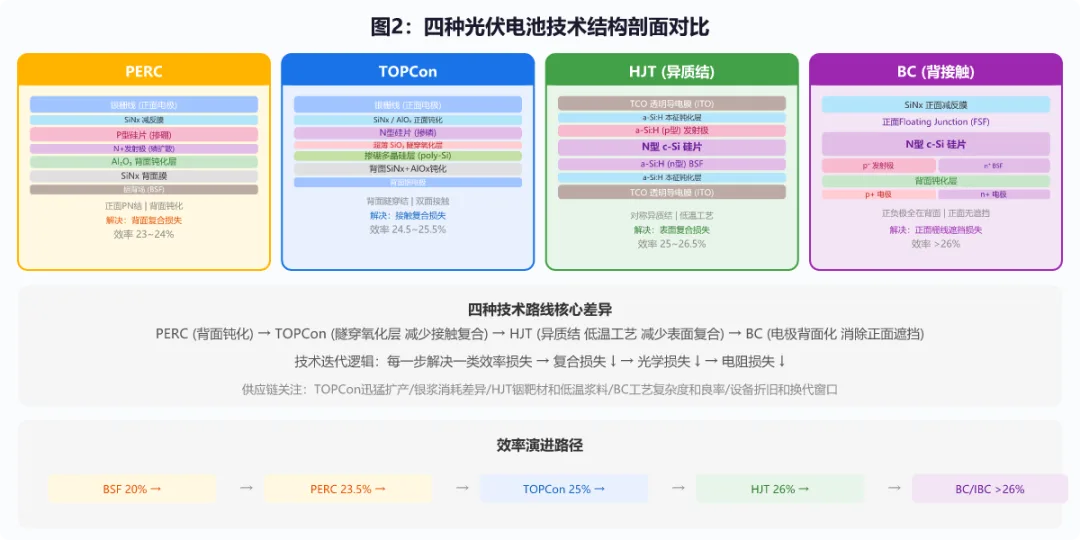
Four columns, each showing the vertical cross-section of one cell, with the PN junction position marked by a red dashed circle. PERC and TOPCon have their PN junction on the front, HJT has heterojunctions on both sides, and BC has its PN junction entirely on the back. Supply-chain reading: more layers means more process steps means greater yield challenges. HJT has the fewest layers but uses low-temperature thin films, TOPCon has a moderate layer count closest to existing lines, and BC has the most complex rear structure.
Figure 3: Solar efficiency loss map
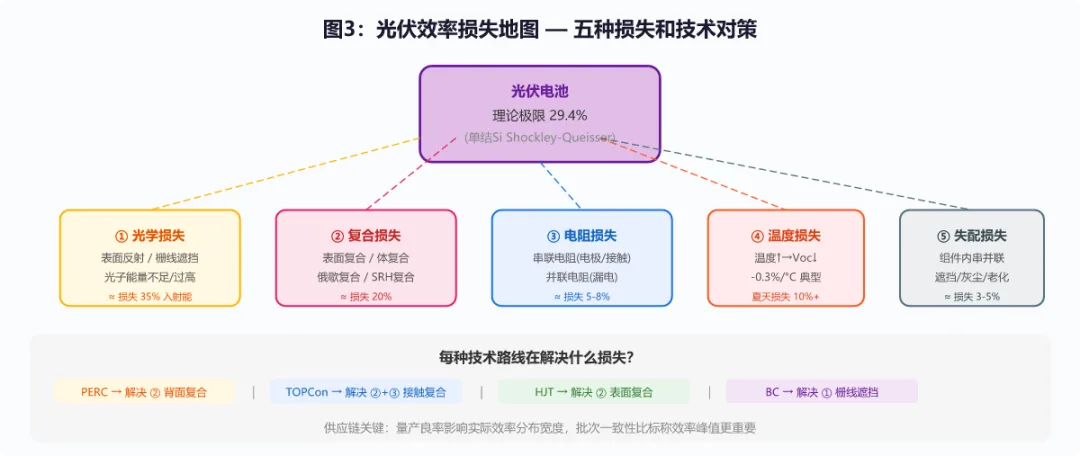
The battle of technology routes is mainly about improving the losses in the second and third rings. No single technology can perfectly solve all losses at once. Supply-chain reading: when you compare the efficiency gap between two technologies, ask clearly which loss layer the difference comes from, because that determines whether the gap is real or only a lab result, and whether it holds up under different conditions such as high temperature or weak light.
Key Terms in This Issue
| Term | English | One-line explanation | Why supply chain should know |
|---|---|---|---|
| PERC | Passivated Emitter and Rear Cell | A passivation layer added on the back of a P-type cell to reduce recombination | Largest installed base, most mature supply chain, easiest replacement |
| TOPCon | Tunnel Oxide Passivated Contact | An N-type cell using a tunnel oxide to reduce contact recombination | Current mainstream N-type route, watch yield and silver paste |
| HJT | Heterojunction Technology | Crystalline-amorphous silicon heterojunction with double-sided passivation | High efficiency potential, big equipment investment, watch silver use and targets |
| BC/IBC | Back Contact / Interdigitated Back Contact | Electrodes moved entirely to the back to eliminate shading | Complex process, yield challenge, patent constraints |
| Passivation | Passivation | Covering the silicon surface with a material layer to reduce defects and recombination | Passivation quality determines degradation and lifetime |
| Silver Paste | Silver Paste | Silver-bearing paste used to make conductive electrode gridlines | Silver price affects cell cost, HJT silver use is a focus |
| LID | Light Induced Degradation | Light causes efficiency drop in P-type modules | LID must be considered in P-type module warranty |
| LeTID | Light and elevated Temperature Induced Degradation | Light plus high temperature degradation, which N-type can also experience | A degradation focus for N-type modules |
Common Misconceptions
Misconception 1: TOPCon is just an upgraded PERC. Correct understanding: TOPCon uses N-type wafers (PERC uses P-type), and the passivated contact design concept is completely different from PERC. Although some PERC lines can be upgraded to TOPCon, they are two generations of technology.
Misconception 2: HJT can already fully replace TOPCon. Correct understanding: HJT has high efficiency and a low process temperature, but large equipment investment, high silver paste consumption (about twice that of TOPCon) and a need for targets. Each has its suitable scenarios and customer groups.
Misconception 3: The highest-efficiency technology must be the best. Correct understanding: you have to look at total cost, including mass-production yield, material cost (especially silver and targets), degradation, temperature coefficient, weak-light response and supply stability. Rated efficiency is only one dimension of technical evaluation.
Misconception 4: A BC module has no front gridlines, so its efficiency must be the highest. Correct understanding: BC moves electrodes to the back, eliminating front shading loss, but the rear process is more complex and the rear resistance path is longer. The efficiency advantage of BC is clear under specific conditions, but it is not optimal in every scenario.
Supply-Chain Focus Points
Choosing a technology route equals choosing supply stability for the next 5-10 years.
Capacity and supply: PERC has the largest capacity but is being replaced by TOPCon. When evaluating suppliers, look at their N-type capacity share and ramp-up progress.
Silver paste dependence: silver is the second-largest cost item in a cell after the wafer. HJT silver consumption is a cost bottleneck the industry watches (low-temperature silver paste is more expensive).
Degradation and warranty: N-type modules generally degrade less than P-type, but LeTID performance varies between manufacturers. In warranty negotiations, get the specific degradation curve.
Spare-part matching: replacement modules must match the original technology route and batch parameters. Connecting modules with different PN junction designs in series causes mismatch loss.
Patent risk: BC technology patents are concentrated in a few companies, so domestic substitution and the spare-part market for the supply chain may be limited.
Supply-chain note: choosing a module technology route is not just about today's efficiency and price, but a prediction of supply stability and spare-part availability over the next 25 years. TOPCon is currently the "high-certainty" choice, HJT is the "high future potential" choice, and BC is the "high value in specific scenarios" choice.
Take It Away in One Sentence
PERC repairs the back, TOPCon repairs the contact, HJT repairs the interface, and BC repairs the shading. The underlying logic of the competition among these four technologies is patching different spots on the efficiency loss map, and your procurement decision is a multi-objective balance among maturity, cost, efficiency and supply security.
Ooitech's View
Ooitech believes: PERC, TOPCon, HJT and BC are not a race for a single efficiency number, but four different patches on the efficiency loss map, and the smart choice is the one that balances maturity, cost, efficiency and long-term supply security.